Filling the landscape with Solar Utility Nodes.
Open sourcing the solution of small scale electrification.

Showing posts with label Technology. Show all posts

Friday, January 17, 2014

Internet is Back!

So after Lydia left (see the initial setup in this post) there seemed to be some mishaps with the internet in Lwemodde. The dish was not providing a strong signal and their modem did not appear to work. They traded the Airtel one for a UTL modem in the hope that that would provide a better situation. I think they were given some crappy useless modem – didn’t seem to work.

They still had the router that they bought from the Airtel shop which will route internet from the USB modem to their three computers. Their netbooks are basically just a smartphone with a keyboard and large screen. They run Android’s Jelly Bean 4.1 operating system which means they are basically only useful for browsing the web. This is why they were so cheap I assume. The battery life is close to 0 and you don’t have to pay for the MAC or MS OS. Just being able to browse the internet is fine though for the majority of their purposes. Their third computer was brought in by Junior. It is a Pentium 4 and it runs Windows XP. We can connect it to the router via ethernet and it works just fine.

While we were setting up everything and testing out the computers, the power, as it always does in Uganda, went out and so we did what we loved to do – run things from our solar utility node. We quickly connected the router’s power port to the 5 V phone chargers that are powered by the12 V battery. The netbooks also run off 5 V provided that you dedicate an entire charger to each of them since they draw 2 A each. The router and the computers worked off solar power and so even in periods of long blackout they should have no trouble accessing the internet.

So, how did we get internet to function? I explained the setup in this way to them. There are 3 connections that need to be made.
1. Modem to 3G cell network. (Actually we can only get 2G out there)
2. Modem must be able to talk to the router.
3. Wifi connection from computers to router.

I worked backwards starting with connection 3 and making my way to 1. I explained the concept of IP addresses and how to access the router once a wifi connection is made. That would be to open a browser and go to address 192.168.0.1. Once we logged into the router I explained what the different settings were, the difference between WAN and LAN and how to check on the status of the modem. That brought us to connection 2. After that was understood we tried to perfect connection 1.

Now just plugging the modem into the router where it sat initially actually did allow for a 2G connection and internet was accessible. It was just unusably slow. In different locations it was slightly faster and slower. We tried putting the modem at the focus of the satellite dish and moving it a bit from side to side We actually got less reception (0 bars) compared to inside (2 bars). My thinking was that it was too fiddly and uncertain to use a perfect parabolic dish at this stage so we focused on moving the modem on the inside of their shop. Bizarrely, the best reception was towards the back of their shop.

That night I went home and used my internet to research methods of improving 3G signal. I quickly came across this video. In the video you will see that pretty decent signal enhancement can be attained by just putting the modem in a saucepan. Yes, this is not parabolic and not focal at all but I think the theory is that you will capture some waves in a wide area and just make them bounce in a fashion which is more likely to hit the modem antenna. I stressed to them that it was important to use a metal pot to allow for this bouncing of EM waves to occur.

The next day we found a pot, as you will see in the pictures below, and tested it. Outside of the pot we couldn’t load the page http://speedof.me which is a simple speed test website. Just a side note, I have never understood why http://speedtest.net thought it was a good idea to fill their page with heavy flash scripts to just do a speed test. If you are doing a speed test it is likely that you don’t have much speed in the first place…..why therefore make the page full of unnecessary data. Seems really stupid.

Junior (left) and Betty (right) testing out the net. You can see the modem in a cooking pot. This was one of our best locations.  As Murphy would have it, it is in the most inconvenient place.
Inside the pot, at the very back of the room, we got 0.03 Mbps speed on average. This was after about 3 tests. Our best location gave us 0.13 Mbps and we were able to stream bits of YouTube video. Junior was very happy to see his favorite music video playing.

I told them to just keep experimenting. Use different sized pots, place the modem in different places in the pot and place the pot in different places at different angles. It will just be a lot of trial and error but I think their internet may just become useable. This is a pretty cool service for them. The closest internet for the surrounding villages is in Kalisizo, and even then it barely works there.

Here you can see all three computers. The router is on top of the monitor.

Two coffee farmers which wandered into the shop got to see the Wikipedia page for coffee for the first time ever.

They also found an article about Ugandan coffee exports going up 7% in the last year.

More internet!

Now that internet is at Lwemodde it will be easy for them to contact Lydia and myself about questions they have or simply research the answers themselves. They still want something to help them learn to type rapidly and so I will work on something which doesn’t use the internet for that. I was thinking of just coding something simple in JavaScript which will run in the browser. That will allow for basic graphics and it should function on all three computers. I can attach the HTML page in an email and they can load it on each computer.

Back To Malembo

Yesterday I went to Malembo and we did 3 major things:
1. Speak to Alex about how operation of the grid has been going.
2. Speak to 3 clients about the service.
3. Explain how the next upgrade of boost/buck converters will help.

Interview with Alex:
Alex is a man who is linked to the Lwemodde youth group and effectively works for them in the small fishing village of Malembo. He runs a number of services. Firstly he runs 3 shops. One for clothes, one for drinks (like water, coke, etc.) and one for utilities. In this town, utilities can be batteries, fishing paddles, superglue, rubber from tire tubes and other random items. Each night Alex uses a petrol generator and inverter to run the town’s cinema. It consists of some camping style pews and a moderately sized cathode ray TV. See photos below. Apparently each night it packs out and he charges only 300 Ugandan shillings (0.12 USD) per head.

Back of the cinema.

Front of the cinema.
To give you a better idea of how the grid looks today, I have taken a video which follows the wires from one client to the power station. You should get a sense for the type of town this is.


Control station. Much more packed now.

Fuse rack #1.

Wires running from the roof.

Quite a few customers are in this direction.

In the interview, Alex first gave me something to think about. He noticed that some wires were starting to become non-conductive and upon dissection would turn out to have very weak cracked copper threads as well a dust inside the wire which looks like ash. He said this only happens to the negative wires.
            Although I cannot be sure, my guess was that too much current was passing through the negative wires and very slowly breaking them. If you see this post you will see our grid design which has a dedicated wire for each positive line to a lamp but a communal negative for many lamps. We required this design to implement our fuse system to stop clients from drawing current beyond the amount they have paid for. Each lamp draws 135 mA and so I told Alex to put only 4-5 lamps per negative wire. After that he can just send another negative wire. Hopefully this solves the issue.

During the interview I learnt that Alex currently has 10 clients and had more prior to now. In the past he has had to disconnect them due to paying their bills. Alex said that in the first and second week of not paying he would just warn the customer. In the third week he would remove the client’s fuse at the power station and so they would still have the hardware but no light. In the fourth week he would remove the wires, lights and switch. The hardware could then be used on a new client. I think this is a pretty good policy and apparently these threats have turned some people into regularly paying customers.

I asked Anita, who is a coordinator for the Foundation of Sustainable Development, the group and Alex why some customers did not pay. Was it because of a lack of money? The cost is only 300 shillings per day but perhaps this is a lot for some people. They all gave me the same answer which was that everyone has the money for this service but for some it is not a priority. It definitely is a priority for some clients as I'll discuss later but for some they have a different mentality. It was explained to me in this way – some people understand that they have lived there for many years without electric lights and only enjoyed the lights for maybe 1 month. If they get disconnected it’s not such a big deal because they know that they can just continue as they did in the past. I guess that is fair enough but that is an interesting thought when in many cases the Malembo Microgrid service is a much cheaper alternative than other lighting methods.

Next I asked how Alex uses the manual as I was very interested to see the impact of it. I know that Baale, the chief of phone repair, founder and treasurer of the youth group, takes the Lugandan edition manual absolutely everywhere he goes. Lydia believes that he sleeps with it every night. So Alex said that he will refer to it when he forgets something technical. I asked for an example and he said the most frequent thing he looks up is the section explaining how to use the volt meter. This makes sense since he has to use the meter a lot to check on the system’s health and also wire people up. Great to see that the manual is useful and the Lugandan translation was worth it!

On that - I was speaking to my host brother (grade 10) last night and asked if he knew of any science books which are in Lugandan. He said that he had never seen one and I know that in university they use only English textbooks. I have a feeling that our manual is the only Lugandan book on electrical engineering that exists.

Client Interviews:
Interestingly, 9 out of the 10 clients are shop owners. Each shop owner has a duel room complex which serves as a shop and a home. Only 1 client has a light exclusively for their home. Some of the previous clients did use a light for their house but they seemed to be the ones who did not pay. Shop keepers are the ones who pay is the general rule.

Below is a bunch of collated results based on all three interviews but differences between each have been outlined. Two of the clients owned food/drink shops and the other client owned a salon.

Each of these clients pay 9,000 shillings per month which is roughly 3.6 USD. Each client, when asked, stated that the price was good but one client playfully told us that “it is good, but it should not go up. Keep it like this.”

The first two clients were quite close to the power station. Probably only 20 meters of cable was needed between their light and the battery. They both said that the light was bright enough for their purposes. The third client who is very far away (bearing in mind that this is a 12 V grid) said that is also bright enough which I did not expect. I assumed the voltage drop across the wires would have kicked in enough to cause a decent loss of brightness.

When asking about a negative of the service one of the clients stated that after a cloudy day/period the lights can be quite dim and so fixing this would be very helpful. Alex does not charge for nights which give very dim lights and in fact will sacrifice phone charging services in the day if it is cloudy to preserve as much energy as possible for the lights at night since those are under written contract. I really like this sort of customer care that Alex gives.

Before these lights were installed one client used a kerosene lamp each night and the other two used a torch (“flash light” for the North American folk). The client needed 2 kerosene lamps each night. One for the shop and one for her bedroom which cost her a rough 1,000 shillings per day in kerosene and each lamp costs 11,000. Considering she now pays 9,000 per month this is far better. The other two clients used torches that cost 4,000 a piece and would cost 400 shillings in batteries each day. This is 12,000 shillings per month and so again the microgrid is cheaper. It was noted that the mircogrid’s LED light was better because it lights up a very wide area while the torch was quite directional and irritating to use because you had to move it around a lot which was a hassle. Also, apparently these torches were quite prone to breaking. Probably yet another case of dumping ultra-cheap Chinese products.

There is a clear health benefit by allowing someone to not have to use a kerosene lamp every night of their life. Additionally there may be an environmental benefit by giving consumers an alternative to buying small batteries every day for a flashlight however I don’t like to make such judgments because the microgrid on the other hand uses solar panels, wires with plastic sheaths and a lead-acid battery. Fabrication of solar panels is intensive and lead-acid batteries are pretty tough to recycle. Who knows which model is more environmentally friendly?

Both of the shopkeepers who had the food and drink shops said that they used to close between 7 pm and 10:30 pm.. Now they pretty much always stay open till midnight. The salon owner also confirmed that staying open later was easier and all three clients agreed that more customers come at night when the place is well lit up. On shop owner stated that she earns 45,000 shillings extra per week since the light was installed. This, on top of the money saved on batteries for her torch, means that she has an additional 183,000 shillings per month which is 73.2 USD. This is possibly the most impactful statistic that I collected.

The client with the salon noted that although there lamp is bright enough, the few people who have private solar panels in this town have very bright lights. This is an alternative available to the more wealth villagers.

Other Notes:
As we walked around Alex pointed out a set of wires to us that he wants to move to higher rooftops or inside the houses they run over. The threat at the current stage, where the wires are quite low, is theft. Some people have been stealing the wires and some of the sugar connectors we used to splice together wires. I asked what people did with the wires and apparently people use them for rope on their fishing boats (remember these are sort of large canoes) or even an ad-hoc switch for their outboard motors.

System Inspection:
The system in Malembo was in great shape. When I visited it was a sunny day and it was halfway through the day. The battery had already approached a point close to full charge. I measured a voltage of 13.25 V across the terminals and this was with a load of 6 phones on charge. The solar panels still gave a steady voltage and were measured at 19.54 V. All the connections looked solid. Sugars were being used and connections which were bearing lots of current used double wires. The racks of fuses were still in order and apparently only 1 fuse blew during the whole time – 6 months now. The cause is not known but at least this means that we have not had people trying to connect clandestine loads to the grid without permission.

Explaining the Boost and Buck Converters:
This sort of technology and why it is important was explained in this post. I do not have the circuits here yet but a demo pair come in the mail soon which I can use to demonstrate to them.

Junior explaining to Alex what the boost and buck converters will do.


Junior going over the diagram.

Other members and Baale looking on.

What was also discussed was how they physical implementation of these circuits would go. Fuses cannot go on the communal 32 V side of the grid and so fuse racks will need to be placed at the location of the buck converter which will take the voltage back down to 12 V. Housing the fuses and buck converter in a remote location will be tricky considering that we have already experienced theft. One possibility is putting the hardware in a locked bock on the very peaks of a roof. Alternatively, if there is a house which belongs to someone trust worthy we may just put the circuitry there. Perhaps we will offer them a free light with no bills. That will cost us very little especially since they will have the step down converter right there at their place. I am letting them think of a way to deal with this issue and I think they will be able to after some planning and thinking.

Monday, January 6, 2014

Mission 2

So thanks to university debating which recently sent me to India, I am in a somewhat good position to visit Uganda before I make my way to Turkey for an exchange program in Istanbul. I will be in Uganda for just 1 week and so it will be exciting to see how the group and the grid is going.

This is a draft list of things that I will do over this week.
  • Document any expansions on the grid since leaving Uganda.
  • Interview some of the grid clients who use lights at night.
  • See what new practices in grid maintenance have emerged or which practices have deteriorated.
  • Make preparations for the boost and buck converter upgrades (more on this below).
  • Reconnect them with internet. Apparently they lost connection due to issues with their plan - sure this is something they could sort out.
Boost and Buck Converters:
Since the grid we are running is only 12 V there is very large loss incurred when running current over long distance. Power lost will be the voltage drop over the wire multiplied by the current. Since we are using a low voltage we need a relatively high current to get the target amount of power. This theory can be condensed by the following equations:

V = IR .... 1
P = IV .... 2

Sub 1 into 2 and we get: P = I2R. To minimize power loss we need to minimize current. A great demonstration of this principle is here, a video by Julian Ilett.

We have ordered a DC to DC boost converter which steps voltage up and also a buck DC-DC converter which steps voltage down. Both of these work by using a MOSFET to periodically switch an inductor. By changing a pot on the board you can change the frequency of switching and therefore change the output voltage.


It is unlikely that we will have the circuits delivered to the FSD Masaka office by next week so we will just teach the Lwemodde youth group how these circuit work and suggest ways to implement them into their grid. When they arrive they can instal the converters. The basic idea will be to power buildings very close to the power station with the standard 12 V directly from the battery. For areas further away we will step the voltage up to 32 V and then step it down in another part of the village to 12 V and distribute from there.
Some interesting innovation will need to come with this upgrade. Perhaps some isolators for our power lines. May not be necessary at 32 V but it is good preparation if we ever step up to a higher voltage. We will need to make boxes for the step down converters and ensure that they are not tampered with. The converters will need to be strategically placed for efficient distribution and we will need to prove good heat dissipation for safety. Hopefully those massive heat sinks prove effective. Throughout the week I will be blogging to track all progress and learn how the grid has operated since myself and Lydia left the area.

Friday, July 26, 2013

Using a Satellite Dish to Enhance 3G Signal

The inspiration for this project comes from another project undertaken by Duke students last summer: starting an internet cafe in Togo.  The goal is pretty simple, to enhance the signal our modem receives.  A simple fix to this would be even to move the wifi dongle just closer to the tower/in a better line of sight from the tower.  We don't necessarily need the dish and could just use a USB extension to hang the dongle somewhere on the roof of the LYG shop. 

However, we've chosen to go a step further and place the modem on the roof at the focus of a satellite dish that's aimed at the cell tower providing us with our internet service.  This required only some pretty basic stuff, and we got funding for this project from the grant I applied for so we could buy a satellite dish (145,000 UGX/ $58 USD) and 2 1.8 meter USB extensions (30,000 UGX/$12 USD).  The following is more or less a step by step of prototyping:


I underestimated how complicated it is to assemble the frame for a satellite dish.  Much worse than an Ikea bookshelf.

We used the plastic casing that normally points the receiver for a television at the focus of the satellite dish to house the modem and the USB extension.  This way we have an easy thing to clamp onto the holder (which is built to clamp this exact shape) and with some electrical tape and super glue we can seal it pretty well from water.


The glued casing for the modem.

Wrapped with electrical tape to for additional waterproofing.
Mahadi comes to help!

In attaching the satellite dish to the roof, we first nailed a piece of wood to the tin roof (there are wooden beams running under the tin, so each nail ended in a wooden beam) and then nailed the satellite dish's mounting base to this piece of wood.  We didn't use the bolts that come in the mounting kit to attach it because we didn't really have access to the under-side of the roof and nobody was really interested in going to borrow the drill from whoever had it.  It's actually more stable than I was expecting, a pretty solid mounting. 


Our goal.  It's hard to see in this picture, but is in fact quite close to the shop.

Aiming the dish: to maximize speed, the dish should be aimed directly at the cell tower that is your internet service provider.

Installation team! 
Day 2: hooking up the modem.
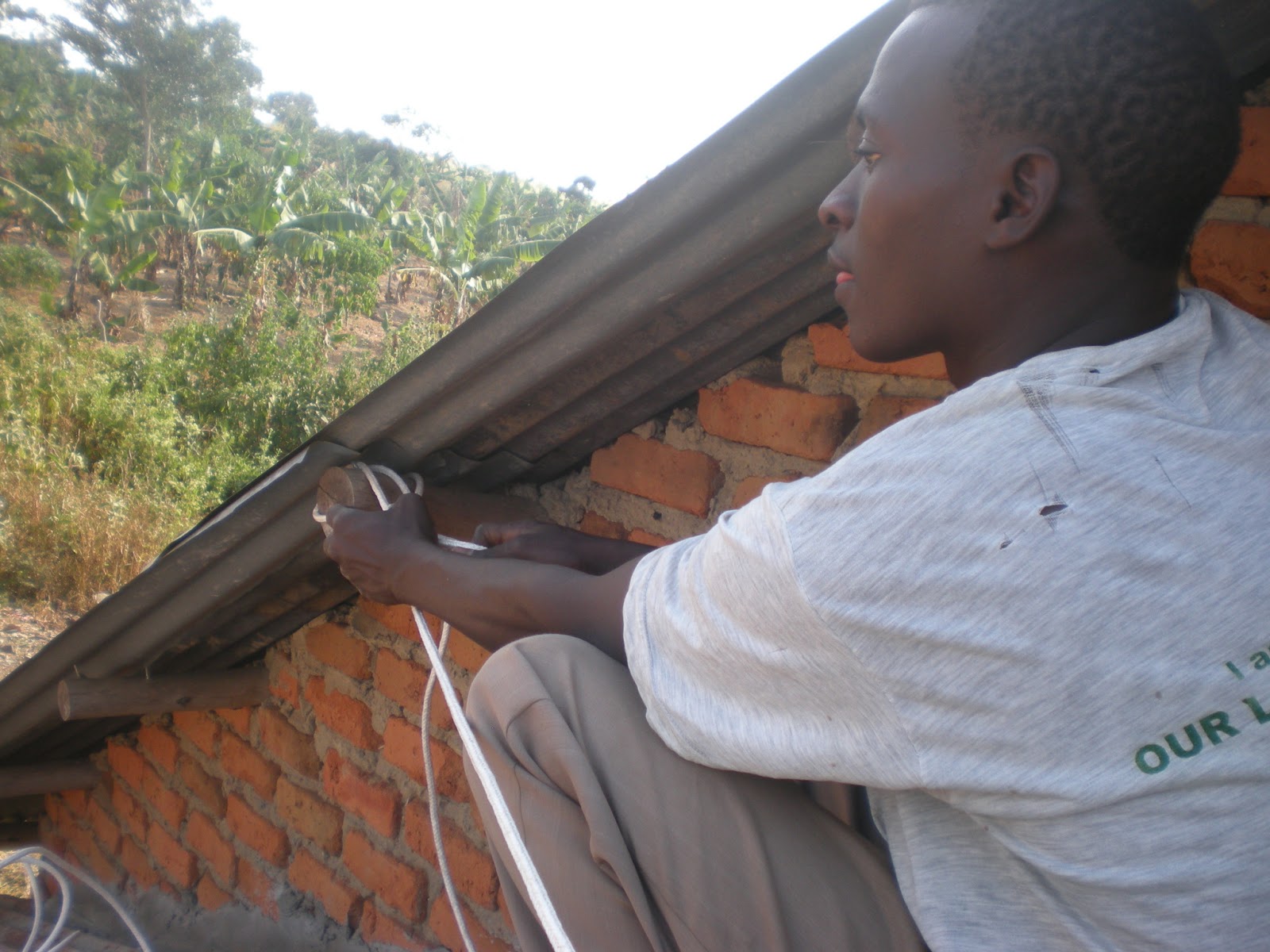
Where the USB extension passes through the roof.  We wrapped a lot of electrical tape around the wire because even though the part of the roof that we passed it through isn't really sharp (it's kind of a corroded part of the roof, we just hit it with a screwdriver to make the hole), we don't want it rubbing against the side and possibly wearing down.
The modem after being positioned to maximize speed!

The roof is starting to get a little crazy...


We went from averaging about 9 kbps internet speed (which is just unusable internet; most of the time internet pages time out before you can load something) to averaging just over 100 kbps.  The internet certainly isn't as fast as the U.S. or even the research facility near my house, but it exceeds lots of local internet cafes and is certainly usable and solid.

Friday, July 19, 2013

Malembo Updates

We've been back to Malembo a couple times this week and last, installing more lights (two monsters of lights too, one we had to cross the main road to reach and had to construct a legitimate telephone pole, and the other was just pretty far away), setting up a second measuring circuit, and just generally checking up on things.

All in all, things are going well and Alex's record-keeping is impeccable.  In two days time we'll have been lighting Malembo for exactly a month, so the first round of profits will be paid back to the LYG (Alex is on a monthly payment plan).

A cool surprise from Alex.  He constructed this so he only has to run two lines to the load box instead of two for every phone and it's a much neater operation this way!

Our new lights.

One of the biggest changes is that Mahadi was unable to find the same lights as before, which means we have to deal with both differences in current drawn and light provided.  These lights draw more current and are brighter than the first round of lights that we installed, drawing 220 mA each.  So far, nobody has complained that their light isn't as bright as their neighbors, but we'll have to wait and see what happens.  They still can fit onto the 300 mA fuses that we've been using, so that shouldn't be an issue.  Obviously, in an ideal world the lights would be uniform and standard, but if there's one thing that we will absolutely not be able to prevent once I leave it's circumstances like this, one type of light is unavailable or more expensive so members opt to buy a different one.  The main thing I made sure is that before installing each light we measured its current usage, so hopefully this becomes habit and just as a check each light is properly measured and rated.
Hi ho, hi ho.  It's off to work we go!

Running the wires.

Precarious perches.

Who would we be without our broad fan-base?  Apparently lights-watching is a popular activity in Malembo.
You'll have to look carefully, but our first real power line crosses this road, the main road into Malembo.  It had to be high enough to allow the big trucks that carry fish out of Malembo on a regular basis could pass.

Wire problems.

The power line!

Raising the wire.

Mo' contracts, mo' money!    


Monday, July 15, 2013

Circuitry Lessons: Round II


This past week we returned to class with the Lwemodde Youth Group, having been remiss on reviewing and reinforcing the principles we originally taught during our lessons on power.  Everybody was incredibly thrown off, trying to come back and just remember the functions of components like op-amps and voltage regulators.

It helped a lot to have grant funding finally (I picked up the wad of cash Wednesday morning!) because I could print an English manual (its final version) and a Luganda manual (the as of yet unedited version; Julie has been line editing the typed version this weekend) to have for reference.  The table/components section is the most often referenced, and it doesn't seem like either version has been read cover-to-cover yet, meaning the more wordy sections haven't really been looked at.  It's hard to tell what people think yet though since we do only have two copies.

Our goal with these lessons was to have the group build the same measuring circuit that their box has to place in Malembo (right now, Alex has a multimeter for every time he wants to determine current or voltage).  Our lessons started by walking through the circuit diagram for the measuring circuit, so that it was clear how the circuit functioned and what path was followed by current when different switches were engaged.  This circuit is just a larger version of one of the practice circuits we built with them (a phone battery measuring circuit), but it's been so long since we did that and it is a large circuit that everybody had a lot of trougle walking through the diagram.  (Also: the group saw little reason to build the circuit based on the circuit diagram when all we would have to do is open up their box and copy the circuit layout, i.e.: which pin goes in which hole.  This is a cop-out because to build off a circuit diagram, you understand current flow and connections, to build off an already constructed bread-board you're basically copy-pasting.)

After people felt ok with the diagram, we started building.  A short demo in soldering onto a circuit board and Bbale was a pro.  Most people did practice soldering once, but Bbale really soldered the whole circuit board that we built.

When it came to construction, I had whichever members currently present assemble 3 components at a time using the circuit diagram and think through the function of that piece of the circuit.  Then I would check it and if it was right, Bbale would solder and we'd keep moving.

When we finally got it constructed, the circuit didn't work hooked up to the system in Lwemodde.  And while everyone had developed some level of comfort with building the circuit and soldering, the only way to try and fix it that people could think of was to go back over the diagram and the circuit and try and figure out if something had been skipped.  I tried to teach people how to use the multimeter to determine if a component isn't functioning correctly in the circuit by measuring voltages, testing connections, and measuring resistances, but people weren't super interested in that and it was hard to get everyone to crowd around the box, which is deliberately hooked up in an out-of-the-way place and hard to get more than one person to.  Ultimately, it seemed as though the voltage regulator wasn't functioning right (instead of 12 V as output, this one was delivering maybe 7) and then one of the opamps was blown (LEDs 1, 2, and 5 lit up, while 3 and 4 were dark after we replaced the voltage regulator.  Replacing the op-amp fixed that).  I think one thing that I'm planning on re-emphasizing at some point is trouble-shooting and kind of the basic things to check in a similar situation.

Tuesday, July 9, 2013

Foiled Again!

Screws: bought 20 for 1,000 UGX (or $0.40 USD) in Masaka, unavailable in Kalisizo.

Installing screws on a roof was much more difficult, and the result was more crinkles in the foil than I'd like.  However, the screws are much more solid!  Definitely a necessity.  Raising/lowering mechanism still to come.

Best position to screw in screws from.  We had to bend it so the wing wasn't in the way of the screwdriver.

Maximum occupancy on Ugandan ladders: 2.

We had to gouge out a little bit of the wood in the frame because reattaching the hinge it shifted and was bumping into the frame so it wouldn't extend properly.

Raising and lowering the panel felt much more stable (if still pretty heavy).

Safety rope tying time!