Filling the landscape with Solar Utility Nodes.
Open sourcing the solution of small scale electrification.

Friday, July 19, 2013

Internet and Computers in Lwemodde


I'm afraid I've gotten terribly behind on keeping this blog up to date.  Without Julian here, it's been tough to keep up with everything that has to be done (work in Lwemodde and Malembo, errands in Masaka/occasionally Kalisizo, and the blog) and so this seems to have fallen by the wayside.  With that being said, it's time that there was a proper update about the status of internet and computers in Lwemodde.

We were shipped computers on July 2nd and are awaiting their arrival at the FSD Office (it's a little disconcerting that part of the mailing address contains the phrase "Across from the DFCU Bank and above Pride Microfinance," but it seems to have worked for others in the past).  We placed an order for two netbooks (http://www.everbuying.com/product409483.html) costing $121.49 USD each from a Chinese site called Everbuying.com.  Had everything gone as planned, we would have had the computers right now, but due to a lot of logistical  problems, that ship date was delayed to July 2nd.  (I think I've spent a total of eight hours on the phone with different customer services, and exchanged a total of 87 emails with customer service representatives, but the short version is that we began the ordering process while Julian was still here, and then it took two weeks for them to finally put it through, and at this point the shipping was also messed up so the packages are shipping via flat rate shipping instead of DHL. If you're considering using Everbuying for something in the future, we wouldn't recommend it despite their computers being incredibly cheap.)

So, at this point, shipping was predicted to take between 18 and 20 business days, meaning they should arrive by the 29th.  As of yesterday the package arrived in Kenya, so it's looking doable.  I'm getting incredibly nervous though that the packages won't arrive before my last day in Lwemodde on August 2nd.  For the time being, I've been teaching people how to use a computer with the laptop I brought: http://www.amazon.com/dp/B0085RV13U.  Most members have never used a computer, and those who have have used exclusively really old PCs, the kind that tend to be a dime a dozen around Kampala.

Our internet service comes from Airtel, a phone company, and it's incredibly slow (usually between 0 and 10 kbps, which means you generally have to count to 5 waiting for a page to load, depending on the contents of the page).  However, hopefully once we hook up a satellite dish facing the cell tower we'll be able to increase the speed significantly.  (Mahadi is on his way to Kampala today, so hopefully we'll have a satellite dish ready to install on Monday.)  The device itself that provides internet is a USB stick that you can either insert into a computer or onto a USB port on a router, which is what we will eventually do.

The USB stick contains a SIM card, which you can load money onto the way you would load money onto any phone's SIM card (so by buying an airtime card with a code from a vendor, and then entering a command *155#thecode# either on a computer that's using the internet or on a phone with the SIM card inserted), and then from there you can select which plan to buy online.  The plan we currently have is a 2 GB for one month plan because that's what comes when you buy the router, however with the internet cafe fully functioning we'll buy the unlimited data for one month plan to accommodate demand.

 With internet and my laptop, I've been teaching people about basic internet functions, getting people used to touchpads and typing (which is something I've realized I take completely for granted.  People are the most basic sort of finger peckers, namely the type who aren't used to the QWERTY arrangement and so they have to visually search for each letter.).  This has basically been setting up Gmail and Facebook for all different members, and then also working together on a web site for the Lwemodde Youth Group.  It's amazing how many little tips and tricks, like double clicking and the shift bar, that I find intuitive and people just learning computers don't.  If you want to check out our web site in its early stages, here you go:

Monday, July 15, 2013

Circuitry Lessons: Round II


This past week we returned to class with the Lwemodde Youth Group, having been remiss on reviewing and reinforcing the principles we originally taught during our lessons on power.  Everybody was incredibly thrown off, trying to come back and just remember the functions of components like op-amps and voltage regulators.

It helped a lot to have grant funding finally (I picked up the wad of cash Wednesday morning!) because I could print an English manual (its final version) and a Luganda manual (the as of yet unedited version; Julie has been line editing the typed version this weekend) to have for reference.  The table/components section is the most often referenced, and it doesn't seem like either version has been read cover-to-cover yet, meaning the more wordy sections haven't really been looked at.  It's hard to tell what people think yet though since we do only have two copies.

Our goal with these lessons was to have the group build the same measuring circuit that their box has to place in Malembo (right now, Alex has a multimeter for every time he wants to determine current or voltage).  Our lessons started by walking through the circuit diagram for the measuring circuit, so that it was clear how the circuit functioned and what path was followed by current when different switches were engaged.  This circuit is just a larger version of one of the practice circuits we built with them (a phone battery measuring circuit), but it's been so long since we did that and it is a large circuit that everybody had a lot of trougle walking through the diagram.  (Also: the group saw little reason to build the circuit based on the circuit diagram when all we would have to do is open up their box and copy the circuit layout, i.e.: which pin goes in which hole.  This is a cop-out because to build off a circuit diagram, you understand current flow and connections, to build off an already constructed bread-board you're basically copy-pasting.)

After people felt ok with the diagram, we started building.  A short demo in soldering onto a circuit board and Bbale was a pro.  Most people did practice soldering once, but Bbale really soldered the whole circuit board that we built.

When it came to construction, I had whichever members currently present assemble 3 components at a time using the circuit diagram and think through the function of that piece of the circuit.  Then I would check it and if it was right, Bbale would solder and we'd keep moving.

When we finally got it constructed, the circuit didn't work hooked up to the system in Lwemodde.  And while everyone had developed some level of comfort with building the circuit and soldering, the only way to try and fix it that people could think of was to go back over the diagram and the circuit and try and figure out if something had been skipped.  I tried to teach people how to use the multimeter to determine if a component isn't functioning correctly in the circuit by measuring voltages, testing connections, and measuring resistances, but people weren't super interested in that and it was hard to get everyone to crowd around the box, which is deliberately hooked up in an out-of-the-way place and hard to get more than one person to.  Ultimately, it seemed as though the voltage regulator wasn't functioning right (instead of 12 V as output, this one was delivering maybe 7) and then one of the opamps was blown (LEDs 1, 2, and 5 lit up, while 3 and 4 were dark after we replaced the voltage regulator.  Replacing the op-amp fixed that).  I think one thing that I'm planning on re-emphasizing at some point is trouble-shooting and kind of the basic things to check in a similar situation.

Tuesday, July 9, 2013

Project Development and Capacity Building Grant

Today we finally heard back from a grant that I applied for a few weeks back (actually, submission date was the day Julian left Kalisizo), and we received full funding!  If you are interested in checking out the grant, which incidentally would provide you with a rough sketch of the work I'll be doing for the next four weeks (I realized that today looking on a calendar I have exactly four weeks left until I fly out of Entebbe International Airport.  Time is disappearing.), then you can go to the Project Documents page and see the budget, workplan and application I submitted.  Our response letter can be found here:


The grant is through the Foundation for Sustainable Development, and is only available to people who were placed with host organizations/host families for work by that organization.  It, as it's name suggests, targets sustainable development projects that aim to increase the long-term ability of an organization to deliver a service.  It cannot be used for capital investments (specifically noted on no-nos were computers, which was upsetting, because scoring a high-capital investment like a computer, a router, etc. would have made our job a lot easier), so the work plan that will use the grant funds is focused on the teaching/experimenting aspect of our project. 

Foiled Again!

Screws: bought 20 for 1,000 UGX (or $0.40 USD) in Masaka, unavailable in Kalisizo.

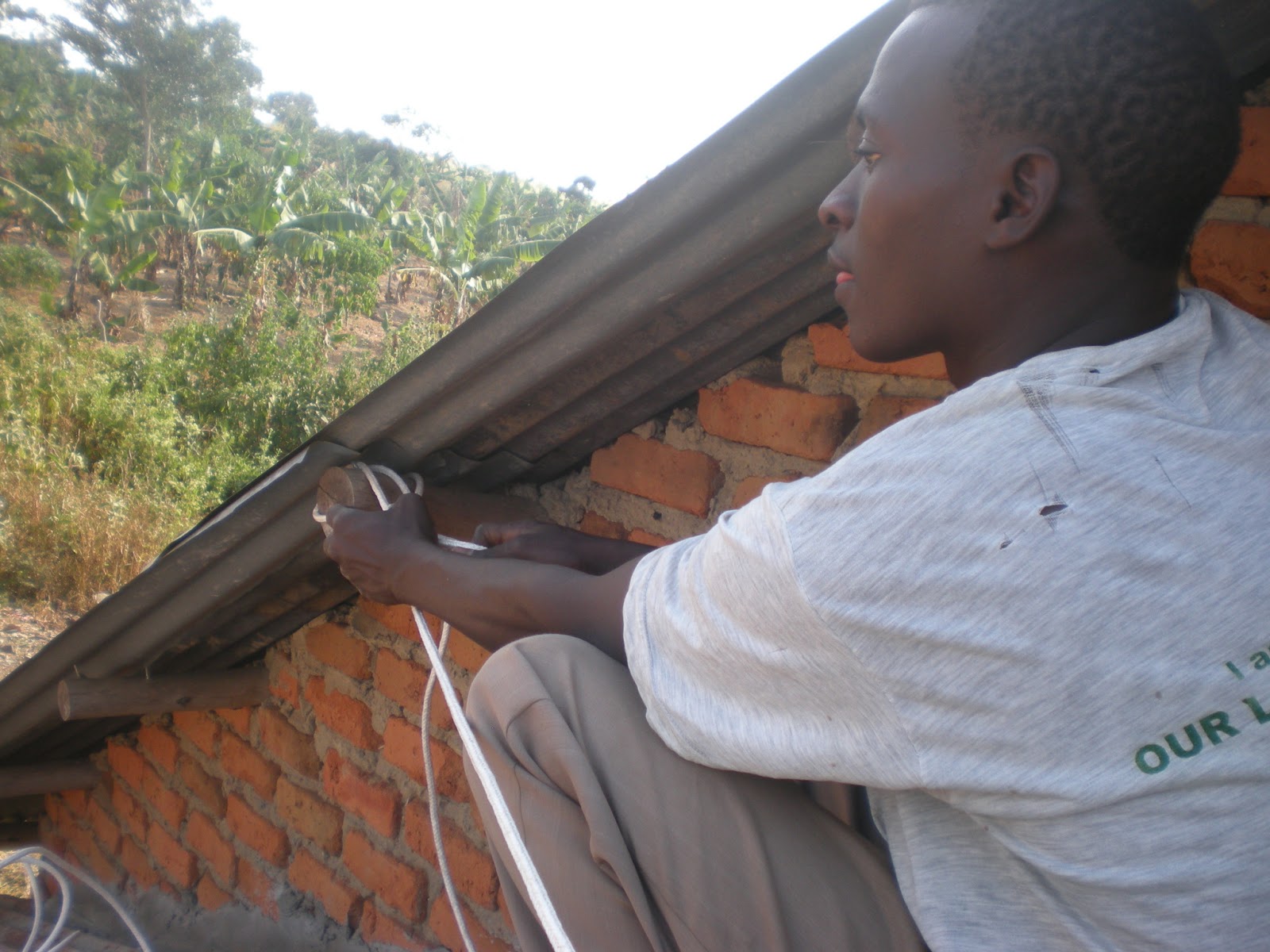
Installing screws on a roof was much more difficult, and the result was more crinkles in the foil than I'd like.  However, the screws are much more solid!  Definitely a necessity.  Raising/lowering mechanism still to come.

Best position to screw in screws from.  We had to bend it so the wing wasn't in the way of the screwdriver.

Maximum occupancy on Ugandan ladders: 2.

We had to gouge out a little bit of the wood in the frame because reattaching the hinge it shifted and was bumping into the frame so it wouldn't extend properly.

Raising and lowering the panel felt much more stable (if still pretty heavy).

Safety rope tying time!

Increasing Solar Yield: Reflection!

One of the first things we noticed with our panel was that the trajectory of the sun and the orientation of the roof leaves a lot to be desired when it comes to intensity and duration of sun exposure.  We lose a fair amount of energy between 8 A.M. and 11 A.M. and then between 3 P.M. and 5 P.M.  These are hours that should be high yield but lots of rays are lost in the poor angles. Hence, our reflection project!  Working on the ground with the panel we experimented with a mirror and with foil, trying to focus the reflection from the sun off of the foil/mirror onto the solar panel.  The ultimate idea was that we would install reflective wings, one on each side of the solar panel, to be raised and lowered depending on the time of day, so in early morning the wing facing just about east would be raised, reflecting early morning rays that would overshoot the panel back onto the panel.  At midday that panel would be lowered, and in the early afternoon the opposite wing would be raised.

Here, I've only drawn the rays that get reflected by the wing so the picture isn't too cluttered.  This diagram shows the panel on the roof, with a wing on either side, one raised and one lowered.  (Note: when a wing is "lowered" it's still not completely lowered because the force that it takes to raise a wing from completely flush with the roof is too much.)
Our on the ground test suggested that close to 900 mA increase in yield follows from using the mirror, and a 600 mA increase in yield follows from using foil (when we were testing, it was a little after 10 A.M.).  For a system that can power 6 additional lights or power 2 additional phones with the margin of increase from foil, we decided that this is worthwhile energy to try and capture.  To buy a mirror the right size would cost between 50,000 and 100,000 UGX and would have to be bought in Kampala, whereas a roll of foil that could make significantly more than 2 wings costs 14,000 UGX at a supermarket in Masaka (those convert to $20 USD, $40 USD, and $5.60 USD respectively).  So we opted for foil on a plywood frame as the cheapest and most easily acquirable option.

The construction and installation of the reflective wings has 3 main challenges: stability, lifting it, and maintaining the reflective surface.

First, to build the reflective surface we used plywood on a mounted wooden frame (our frame wood was incredibly hard and straight, good for our goal of having a totally flat face to spread the foil on, bad for having to saw and nail it).  Before nailing the plywood to the frame, we carefully spread foil over the top of the plywood and then nailed it to the frame, nailing the top of the foil and clamping the folded bit to hold it in place in between the frame and the plywood.  The flatter the frame and the less crinkled the foil, the more rays of sunlight will be reflected onto the panel and not reflected in random directions.

Laying out the frame for the wings.

Folding the foil under the sides of the plywood, so it would clamp in between the plywood and the frame.

After realizing that the nails wouldn't be enough to hold all 3 long strips of foil tight to the wing, we decided to glue the long edges of the foil down to the wood.  Before this, wind easily could have fit into the cracks between the long overlaps, either ballooning the foil out so it got crinkled/was no longer a flat surface, or even ripping the piece.

The finished wing! 
Installation Part #1:

We used the same basic installation plan for the reflective wings that we have been using on solar panels.  The twist here is that instead of bolting the piece of wood that goes on top of the roof to the wing, we attach it via a hinge likeso:
Imagine the purple bit is a hinge.
The panel itself is tall, maybe seven feet (see above, where it dwarfs Obama and myself), so stability on the roof, i.e.: the solidity of the mounting system and its ability to hold the wing there is very important.  Holding the wing upright when wind is blowing is similar to holding a sail in the wind because it has such a large area, and if it falls it might smash the solar panel (this is the one that traveled with me from RDU to Boston, was rechecked and then traveled on to Amsterdam, Kigali, Entebbe, Kampala, Masaka, Kalisizo, and Lwemodde before being mounted on this roof).  So stability is something that I've been incredibly nervous about and that we focused on.

Originally, we nailed the hinges to the panel (after we had already put the foil on, rookie mistake).  It was difficult to prevent the foil from crinkling while we were nailing.  However, with the wing on the roof, it was very clear that nails wouldn't be sufficient.  They were too loose and seemed to be close to being pulled out of the wood from the weight of the panel.  We ended up installing as is the first day, but tied multiple safety ropes and decided not to use the mechanism until we could replace the nails with screws.

The hinges.  Notice nails are driven in halfway then bent to hold the hinge in place.  Ultimately, not a great idea. 

Winching up the foil wing very, very carefully!

Obama works his sealant magic on bolt holes.

What a great looking group!

Screwing in the bolts.

Raising the wing for the first time!  A little shaky at the hinges, but all in all not bad!  Just very very heavy.
I'm sure you've noticed that putting a wing on a roof is all good and fine but doesn't really do anything for you if there's no mechanism for raising/lowering it.  This first bit of the process was completed in the last days Julian was here and the next week, we have since upgraded to screws (see post: Foiled Again!), and are in the process of working towards a raising/lowering system.

With a variety of other irons in the fire, we've been kind of distracted from the reflection project, and for whatever reason the Lwemodde Youth Group members themselves have been dragging their feet about it.  They don't seem to be excited about the project (definitely doesn't have the glamor of circuit-building or internet cafes), and so as a result it's been getting pushed back and back.  I think another element of this might be concern about the safety of the panel, although with our safety rope mechanism, even when it's raised and lowered the wing should have no way it could break free and fall on the panel.  This project will probably be one that we continue through the end of my time here as priorities shift.

Monday, July 8, 2013

Manual!

Hi everyone!

In case you've been interested in reading our manual but have been annoyed that it's taking so long for us to post it here, the wait is over.  A fully updated version of the manual can be found on the right side of the page by following the "S.U.N.scaping Manual" link.  And for those of you who speak exclusively Luganda, you're in luck!  We've also posted that version.  This manual has been totally updated and I'm using it this week while we build circuitry with the Lwemodde Youth Group members, so check it out and follow along!

Tuesday, July 2, 2013

Ca$h Money


In response to a request from some of our readership (Thanks Chris!), I’ve pulled together some rough numbers to address the question of the financial sustainability of the project.  It is true, that the products we’ve been using are not the cheapest options.  LED lights that we use cost UGX 10,000, or twice as much as available florescent 12V bulbs, and the deep cycle batteries that we purchased at UGX 400,000 are maybe eight times as expensive as the car batteries that most people use in similar situations (note: these car batteries are between a third and half of the capacity of our batteries, so it’s not exactly a direct comparison).  However, the lifespan and functionality of the items we’ve been using prove their worth against cheaper options, and it’s not too difficult to see profit in spite of some pretty high start-up costs.

The Malembo Micro-Grid
The Malembo micro-grid is expected to near full capacity (50 lights powered) by the time I leave in early August.  This means that the group would have to invest UGX 500,000 in LED lights at UGX 10,000 each, UGX 65,000 in fuses at UGX 1,300 each, and UGX 90,000 in spools of wire at UGX 15,000 each.  This gives a grand total of UGX 655,000, or about $262 USD.  This is by no means a small sum, and when you consider the investment in the micro-grid by Julian’s and my summer funding as well as the Foundation for Sustainable Development (2 solar panels at UGX 450,000 each, 1 100 Amphour battery at UGX 400,000, and smaller, assorted items), the cost of the system nears $800 USD.  We were lucky that we had the access to kick start development with the capital we brought with us and gained through an FSD seed grant, but ultimately it’s not an unreasonable sum to pay off.

When it comes to earnings, a grid supporting 50 clients earns UGX 15,000 each day.  With these earnings, the group’s investment will be paid off in 44 days of operation.  This doesn’t include the earnings from charging phones during the same month, and the 200 watts of panel and 100 amphours of battery have been calculated to be capable of providing for the current phone charging demand as well as the fifty lights.  After the group pays off its initial investment (and they have managed to set up an agreement with a shopkeeper in Kalisizo to pay for lights they purchase after they earn enough money using them to do so), they will earn UGX 450,000, or $180 USD each month, and in a single month, they could earn enough to add a third solar panel.  In two months, they could purchase a solar panel and another battery.  A day of powering lights for 50 people earns enough money to buy another light and add another customer to the system.  The nice thing about this system is that there are no costs to maintain it; all profits can either be taken as just that, profits, or put towards further expansion of services and profits.

Internet Café
The internet café in Lwemodde will be a little different in that it does have a recurring cost: the internet plan.  The way internet works in Uganda is it is service provided by cell phone companies, the most popular being Orange’s internet plans, which come on an “Orange stick.”  Orange sticks resemble flash drives and just plug into a computer’s USB port, providing internet based on the monthly or 3-monthly plan that you purchase.  We are not using Orange internet, and will be using Airtel’s service (another phone company) because there is an Airtel tower visible from Lwemodde.  This makes service better regardless, but also it is easier to use a satellite dish to enhance the signal since there’s a clear sight line.  Airtel also uses similar devices (although they don’t seem to have a catchy name like “orange stick”) which they offer for UGX 60,000, and they come with 500 MB of data for one month.  This would be a one-time purchase, and then each successive month would require purchasing a data bundle.  However, since these devices only serve for single computers, we’ll be purchasing a router, which is Airtel’s other option for internet services.  The router serves up to 20 computers, so we should be fine with the two we plan on using.  It costs UGX 180,000 and comes with a 2 GB, 1 month plan, and while it is more expensive than buying two Airtel sticks for our computers, it’s ultimately cheaper because you don’t have to buy two separate internet bundles.  The way in which we plan on using the internet, I expect that will soon run out of the initial 2 GB and the ultimate bundle that the Lwemodde Youth Group will use is the 1 month unlimited plan, costing UGX 290,000 per month.  With this assumption in place we’ve done some basic calculations.

Unlike Malembo, all startup costs have been provided for by Julian’s and my summer funding, or from a seed grant from the Foundation for Sustainable Development.  This includes the solar panel, the battery, the computers, and the assorted circuitry/wiring we’ve been prototyping with. 

In internet cafes in larger cities, twenty minutes of internet can be purchased for UGX 500.  I sat down in Addam’s Videography and Internet Café yesterday in Masaka (an hour plus trip from Lwemodde) to test one out, and it’s actually not a bad system; they even have software that locks you out of a computer after exactly 20 minutes, then can be reset to allow an extra minute as you log out of whatever you were using or decide to purchase more.  That internet café in Masaka had eight computers, six of which were full when I was there at 4 P.M.  Junior has insisted that with two computers in Lwemodde, demand will be constant and we’ll have two customers constantly for ten hours a day.  Realistically, I think we can expect about 8 hours of internet purchases per day, because between 11 A.M. and 7 P.M., it seems as though few people are working (people generally go to the fields very early and later so it’s not unbearably hot or sunny) and there are consistently five or six people hanging out in the shop itself, and another fifteen hanging out under the tree across the street.  If you can count on eight hours of internet purchases per day, that’s sixteen hours of internet time between the two computers, which divides into 48 twenty minute segments.  At UGX 500 for each twenty minute segment, that’s UGX 24,000 per day and UGX 720,000 per month. 

I’m still hesitant to assert that demand will be totally constant (although people are getting excited about computers!), but even if you round that figure down to UGX 600,000 each month, that’s more than enough to cover a fee of UGX 290,000 for unlimited internet, and in fact two months of operation would mean more than enough profits to purchase another computer.  The computers we bought totaled UGX 400,000 including shipping, and so two months down the road, the Lwemodde Youth Group could have a third computer and a cool UGX 220,000 to go with it. 

Yes, each purchase that we’ve made has been an investment, especially in this financial environment where a bottle of Coca-Cola costs $0.40 USD.  However, once momentum has gathered, both endeavors have huge potential for profit.  Having a lot of capital to provide for the high initial costs was a great benefit, but “earning back” those costs as an organization will not take long which could allow for continued expansion if the demand for services is there.