Filling the landscape with Solar Utility Nodes.
Open sourcing the solution of small scale electrification.

Tuesday, July 9, 2013

Project Development and Capacity Building Grant

Today we finally heard back from a grant that I applied for a few weeks back (actually, submission date was the day Julian left Kalisizo), and we received full funding!  If you are interested in checking out the grant, which incidentally would provide you with a rough sketch of the work I'll be doing for the next four weeks (I realized that today looking on a calendar I have exactly four weeks left until I fly out of Entebbe International Airport.  Time is disappearing.), then you can go to the Project Documents page and see the budget, workplan and application I submitted.  Our response letter can be found here:


The grant is through the Foundation for Sustainable Development, and is only available to people who were placed with host organizations/host families for work by that organization.  It, as it's name suggests, targets sustainable development projects that aim to increase the long-term ability of an organization to deliver a service.  It cannot be used for capital investments (specifically noted on no-nos were computers, which was upsetting, because scoring a high-capital investment like a computer, a router, etc. would have made our job a lot easier), so the work plan that will use the grant funds is focused on the teaching/experimenting aspect of our project. 

Foiled Again!

Screws: bought 20 for 1,000 UGX (or $0.40 USD) in Masaka, unavailable in Kalisizo.

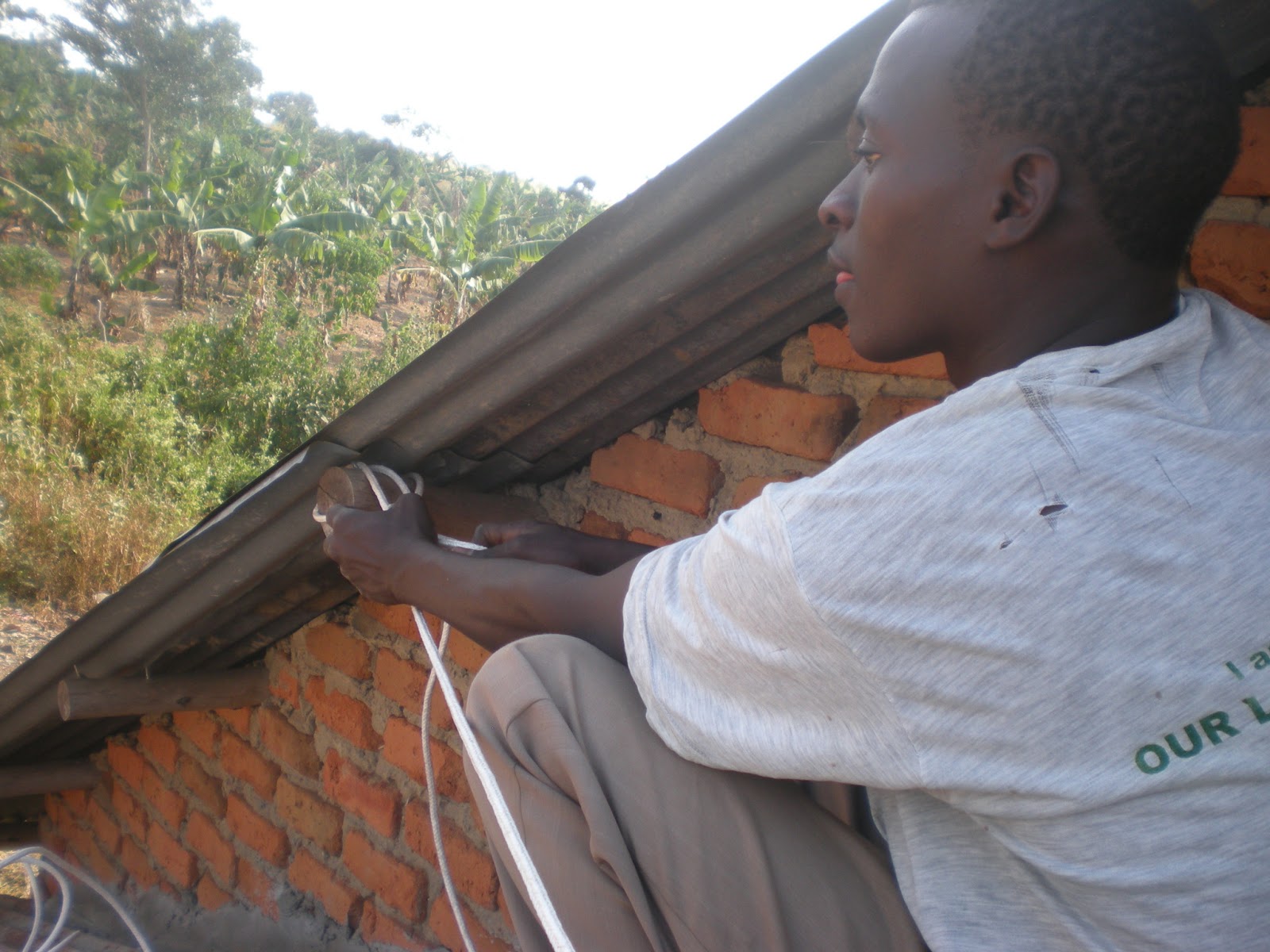
Installing screws on a roof was much more difficult, and the result was more crinkles in the foil than I'd like.  However, the screws are much more solid!  Definitely a necessity.  Raising/lowering mechanism still to come.

Best position to screw in screws from.  We had to bend it so the wing wasn't in the way of the screwdriver.

Maximum occupancy on Ugandan ladders: 2.

We had to gouge out a little bit of the wood in the frame because reattaching the hinge it shifted and was bumping into the frame so it wouldn't extend properly.

Raising and lowering the panel felt much more stable (if still pretty heavy).

Safety rope tying time!

Increasing Solar Yield: Reflection!

One of the first things we noticed with our panel was that the trajectory of the sun and the orientation of the roof leaves a lot to be desired when it comes to intensity and duration of sun exposure.  We lose a fair amount of energy between 8 A.M. and 11 A.M. and then between 3 P.M. and 5 P.M.  These are hours that should be high yield but lots of rays are lost in the poor angles. Hence, our reflection project!  Working on the ground with the panel we experimented with a mirror and with foil, trying to focus the reflection from the sun off of the foil/mirror onto the solar panel.  The ultimate idea was that we would install reflective wings, one on each side of the solar panel, to be raised and lowered depending on the time of day, so in early morning the wing facing just about east would be raised, reflecting early morning rays that would overshoot the panel back onto the panel.  At midday that panel would be lowered, and in the early afternoon the opposite wing would be raised.

Here, I've only drawn the rays that get reflected by the wing so the picture isn't too cluttered.  This diagram shows the panel on the roof, with a wing on either side, one raised and one lowered.  (Note: when a wing is "lowered" it's still not completely lowered because the force that it takes to raise a wing from completely flush with the roof is too much.)
Our on the ground test suggested that close to 900 mA increase in yield follows from using the mirror, and a 600 mA increase in yield follows from using foil (when we were testing, it was a little after 10 A.M.).  For a system that can power 6 additional lights or power 2 additional phones with the margin of increase from foil, we decided that this is worthwhile energy to try and capture.  To buy a mirror the right size would cost between 50,000 and 100,000 UGX and would have to be bought in Kampala, whereas a roll of foil that could make significantly more than 2 wings costs 14,000 UGX at a supermarket in Masaka (those convert to $20 USD, $40 USD, and $5.60 USD respectively).  So we opted for foil on a plywood frame as the cheapest and most easily acquirable option.

The construction and installation of the reflective wings has 3 main challenges: stability, lifting it, and maintaining the reflective surface.

First, to build the reflective surface we used plywood on a mounted wooden frame (our frame wood was incredibly hard and straight, good for our goal of having a totally flat face to spread the foil on, bad for having to saw and nail it).  Before nailing the plywood to the frame, we carefully spread foil over the top of the plywood and then nailed it to the frame, nailing the top of the foil and clamping the folded bit to hold it in place in between the frame and the plywood.  The flatter the frame and the less crinkled the foil, the more rays of sunlight will be reflected onto the panel and not reflected in random directions.

Laying out the frame for the wings.

Folding the foil under the sides of the plywood, so it would clamp in between the plywood and the frame.

After realizing that the nails wouldn't be enough to hold all 3 long strips of foil tight to the wing, we decided to glue the long edges of the foil down to the wood.  Before this, wind easily could have fit into the cracks between the long overlaps, either ballooning the foil out so it got crinkled/was no longer a flat surface, or even ripping the piece.

The finished wing! 
Installation Part #1:

We used the same basic installation plan for the reflective wings that we have been using on solar panels.  The twist here is that instead of bolting the piece of wood that goes on top of the roof to the wing, we attach it via a hinge likeso:
Imagine the purple bit is a hinge.
The panel itself is tall, maybe seven feet (see above, where it dwarfs Obama and myself), so stability on the roof, i.e.: the solidity of the mounting system and its ability to hold the wing there is very important.  Holding the wing upright when wind is blowing is similar to holding a sail in the wind because it has such a large area, and if it falls it might smash the solar panel (this is the one that traveled with me from RDU to Boston, was rechecked and then traveled on to Amsterdam, Kigali, Entebbe, Kampala, Masaka, Kalisizo, and Lwemodde before being mounted on this roof).  So stability is something that I've been incredibly nervous about and that we focused on.

Originally, we nailed the hinges to the panel (after we had already put the foil on, rookie mistake).  It was difficult to prevent the foil from crinkling while we were nailing.  However, with the wing on the roof, it was very clear that nails wouldn't be sufficient.  They were too loose and seemed to be close to being pulled out of the wood from the weight of the panel.  We ended up installing as is the first day, but tied multiple safety ropes and decided not to use the mechanism until we could replace the nails with screws.

The hinges.  Notice nails are driven in halfway then bent to hold the hinge in place.  Ultimately, not a great idea. 

Winching up the foil wing very, very carefully!

Obama works his sealant magic on bolt holes.

What a great looking group!

Screwing in the bolts.

Raising the wing for the first time!  A little shaky at the hinges, but all in all not bad!  Just very very heavy.
I'm sure you've noticed that putting a wing on a roof is all good and fine but doesn't really do anything for you if there's no mechanism for raising/lowering it.  This first bit of the process was completed in the last days Julian was here and the next week, we have since upgraded to screws (see post: Foiled Again!), and are in the process of working towards a raising/lowering system.

With a variety of other irons in the fire, we've been kind of distracted from the reflection project, and for whatever reason the Lwemodde Youth Group members themselves have been dragging their feet about it.  They don't seem to be excited about the project (definitely doesn't have the glamor of circuit-building or internet cafes), and so as a result it's been getting pushed back and back.  I think another element of this might be concern about the safety of the panel, although with our safety rope mechanism, even when it's raised and lowered the wing should have no way it could break free and fall on the panel.  This project will probably be one that we continue through the end of my time here as priorities shift.

Monday, July 8, 2013

Manual!

Hi everyone!

In case you've been interested in reading our manual but have been annoyed that it's taking so long for us to post it here, the wait is over.  A fully updated version of the manual can be found on the right side of the page by following the "S.U.N.scaping Manual" link.  And for those of you who speak exclusively Luganda, you're in luck!  We've also posted that version.  This manual has been totally updated and I'm using it this week while we build circuitry with the Lwemodde Youth Group members, so check it out and follow along!

Tuesday, July 2, 2013

Ca$h Money


In response to a request from some of our readership (Thanks Chris!), I’ve pulled together some rough numbers to address the question of the financial sustainability of the project.  It is true, that the products we’ve been using are not the cheapest options.  LED lights that we use cost UGX 10,000, or twice as much as available florescent 12V bulbs, and the deep cycle batteries that we purchased at UGX 400,000 are maybe eight times as expensive as the car batteries that most people use in similar situations (note: these car batteries are between a third and half of the capacity of our batteries, so it’s not exactly a direct comparison).  However, the lifespan and functionality of the items we’ve been using prove their worth against cheaper options, and it’s not too difficult to see profit in spite of some pretty high start-up costs.

The Malembo Micro-Grid
The Malembo micro-grid is expected to near full capacity (50 lights powered) by the time I leave in early August.  This means that the group would have to invest UGX 500,000 in LED lights at UGX 10,000 each, UGX 65,000 in fuses at UGX 1,300 each, and UGX 90,000 in spools of wire at UGX 15,000 each.  This gives a grand total of UGX 655,000, or about $262 USD.  This is by no means a small sum, and when you consider the investment in the micro-grid by Julian’s and my summer funding as well as the Foundation for Sustainable Development (2 solar panels at UGX 450,000 each, 1 100 Amphour battery at UGX 400,000, and smaller, assorted items), the cost of the system nears $800 USD.  We were lucky that we had the access to kick start development with the capital we brought with us and gained through an FSD seed grant, but ultimately it’s not an unreasonable sum to pay off.

When it comes to earnings, a grid supporting 50 clients earns UGX 15,000 each day.  With these earnings, the group’s investment will be paid off in 44 days of operation.  This doesn’t include the earnings from charging phones during the same month, and the 200 watts of panel and 100 amphours of battery have been calculated to be capable of providing for the current phone charging demand as well as the fifty lights.  After the group pays off its initial investment (and they have managed to set up an agreement with a shopkeeper in Kalisizo to pay for lights they purchase after they earn enough money using them to do so), they will earn UGX 450,000, or $180 USD each month, and in a single month, they could earn enough to add a third solar panel.  In two months, they could purchase a solar panel and another battery.  A day of powering lights for 50 people earns enough money to buy another light and add another customer to the system.  The nice thing about this system is that there are no costs to maintain it; all profits can either be taken as just that, profits, or put towards further expansion of services and profits.

Internet Café
The internet café in Lwemodde will be a little different in that it does have a recurring cost: the internet plan.  The way internet works in Uganda is it is service provided by cell phone companies, the most popular being Orange’s internet plans, which come on an “Orange stick.”  Orange sticks resemble flash drives and just plug into a computer’s USB port, providing internet based on the monthly or 3-monthly plan that you purchase.  We are not using Orange internet, and will be using Airtel’s service (another phone company) because there is an Airtel tower visible from Lwemodde.  This makes service better regardless, but also it is easier to use a satellite dish to enhance the signal since there’s a clear sight line.  Airtel also uses similar devices (although they don’t seem to have a catchy name like “orange stick”) which they offer for UGX 60,000, and they come with 500 MB of data for one month.  This would be a one-time purchase, and then each successive month would require purchasing a data bundle.  However, since these devices only serve for single computers, we’ll be purchasing a router, which is Airtel’s other option for internet services.  The router serves up to 20 computers, so we should be fine with the two we plan on using.  It costs UGX 180,000 and comes with a 2 GB, 1 month plan, and while it is more expensive than buying two Airtel sticks for our computers, it’s ultimately cheaper because you don’t have to buy two separate internet bundles.  The way in which we plan on using the internet, I expect that will soon run out of the initial 2 GB and the ultimate bundle that the Lwemodde Youth Group will use is the 1 month unlimited plan, costing UGX 290,000 per month.  With this assumption in place we’ve done some basic calculations.

Unlike Malembo, all startup costs have been provided for by Julian’s and my summer funding, or from a seed grant from the Foundation for Sustainable Development.  This includes the solar panel, the battery, the computers, and the assorted circuitry/wiring we’ve been prototyping with. 

In internet cafes in larger cities, twenty minutes of internet can be purchased for UGX 500.  I sat down in Addam’s Videography and Internet Café yesterday in Masaka (an hour plus trip from Lwemodde) to test one out, and it’s actually not a bad system; they even have software that locks you out of a computer after exactly 20 minutes, then can be reset to allow an extra minute as you log out of whatever you were using or decide to purchase more.  That internet café in Masaka had eight computers, six of which were full when I was there at 4 P.M.  Junior has insisted that with two computers in Lwemodde, demand will be constant and we’ll have two customers constantly for ten hours a day.  Realistically, I think we can expect about 8 hours of internet purchases per day, because between 11 A.M. and 7 P.M., it seems as though few people are working (people generally go to the fields very early and later so it’s not unbearably hot or sunny) and there are consistently five or six people hanging out in the shop itself, and another fifteen hanging out under the tree across the street.  If you can count on eight hours of internet purchases per day, that’s sixteen hours of internet time between the two computers, which divides into 48 twenty minute segments.  At UGX 500 for each twenty minute segment, that’s UGX 24,000 per day and UGX 720,000 per month. 

I’m still hesitant to assert that demand will be totally constant (although people are getting excited about computers!), but even if you round that figure down to UGX 600,000 each month, that’s more than enough to cover a fee of UGX 290,000 for unlimited internet, and in fact two months of operation would mean more than enough profits to purchase another computer.  The computers we bought totaled UGX 400,000 including shipping, and so two months down the road, the Lwemodde Youth Group could have a third computer and a cool UGX 220,000 to go with it. 

Yes, each purchase that we’ve made has been an investment, especially in this financial environment where a bottle of Coca-Cola costs $0.40 USD.  However, once momentum has gathered, both endeavors have huge potential for profit.  Having a lot of capital to provide for the high initial costs was a great benefit, but “earning back” those costs as an organization will not take long which could allow for continued expansion if the demand for services is there. 

Sunday, June 30, 2013

Goodbye Stranger

About twenty four hours ago, Julian's flight to Dubai out of Entebbe International Airport took off.  I've got another six weeks or so (until August 6th) on the ground here, so the project is far from over, but we'll miss him loads (bonus points if you get the power pun in there)!

One of his last days this past week, we arrived at work to discover the above beautiful sign sitting in their shop (design courtesy of Obama Jr., whose 22nd birthday is today!).  One of the things when we first spoke about branching with the Lwemodde Youth Group was sort of the question of whether or not they wanted to create a brand for themselves, and we showed them the front of my notebook: our project name with a stick-figure sun. 

At which point Obama was off and away, designing not a name for their shop, but a distinctive sign with which to brand it.  Several iterations of this were drawn, and Julian and I were kind of expecting to have a day on which we painted a sign and generally decorated to advertise the Lwemodde shop as an internet cafe and the Malembo shop as a micro-grid.

However it's obvious that we were beaten to the punch, and showed up on one of Julian's last days to find this super snazzy sign.  It was pretty exciting in a selfish way, seeing their sign with their services and name paired with the name we thought of during our first week in Uganda.  If nothing else, at least Julian can leave Uganda knowing that we have made a mark!  Mission accomplished.

But really: I'll miss Julian; the excitement and proactiveness of the Lwemodde Youth Group never ceases to amaze me, and if you're driving along Ddimo Road, now you know where to stop for some high quality phone repair, hair dressing, agricultural advice, and (crossing our fingers!) internet/computer services.  Here's to another six weeks!

Sunday, June 23, 2013

Rome wasn't built in a day, it was built in 4 days!

Today (Friday) we signed the first clients and connected them to our grid.

Alex and this customer signs the first contract ever for the Malembo Micro Grid. She wanted a light in her shop which is across the road from our power house.
Our second client.
Signed contracts!
We ran many wires throughout the day and tried to make them as neat as possible. This usually involved putting them close to house beams under the roof hanging past the building. Each client need their own positive wire because they have a specific fuse on their line but the grounds/return can connect in any way which is convenient. If a client is connected and they already have our wires running past their shop then we attach them to the same negative wire. Considering this means that return current will then build up we have capped a single ground line at 6 lights for now. This was relatively arbitrary but should be well under any sort of maximum current that the wire can hold.


Junior unravels the first reel of wire.
Junior passing wire through roof beams.
Wire going into this clothes shop.
Bulb in place.
Spliced in the switch.
Let there be light!
Ground wire spliced into another ground wire.
Another shop which should be happier tonight.
To create the client contract we discussed the deals that people could sign up for in the days leading up to now. The group decided that 300 shillings ($0.12 USD) per light per day was fair. The wires, sockets, lights and switches are free for people but they will need to pay a 3000 shilling ($1.20 USD) installation fee. The contract was translated using Julie and this made it very easy for people to understand everything. Apart from that Alex does a great job of explain the package to new customers.  The contract in both English and Luganda can be found here.

Some of the clients were challenging to get to; specifically the ones across the street. Putting wires underground would be very difficult because the earth is quite hard and we do not have any easily acquired piping. Our solution was simply to use a pole like any real electricity company. The highest point on our building is the top of this ledge on the roof so we put a nail on the top of that and used that to pivot wire over to another roof where we nailed a pole in the side. This is essentially our first ever power line.

One the left is our roof top and on the right is a client's house.

You may be thinking this is a rough set up. I guarantee that I have seen other real grid lines set up by actual electricians here which look much less legit.
There has been talk of using small step up and step down voltage converters for long distance wires to other parts of Malembo. If we did this we would step up the voltage to 48 V and send then step back down to 12 V in different areas. Doing this we would actually require serious power line poles which I would demand are put in the ground with concrete. We would also need to put small isolators on the poles to hold the wires and potentially even a grounded lightning wire on the top. All of this would be a nice project if we return to see how everything is doing or potentially a second project in another bigger village that the group works on.


On Monday we should be finalizing this grid. Making the wires in the station neater and connecting as many people as possible. As part of the ultimate goal for sustainable development Lydia and I will only give new ideas rather than actually do the building. I am happy with the rate at which Alex and the group members are learning the slithers of electrical engineering necessary to have this grid run safely and with quality. The weekend has just passed and I heard that Alex connected someone one his own which sounds like a great start to this business.